Registry Tribunal: Non-Physical Meetings in Closely-held Companies
Registry Tribunal: Non-Physical Meetings in Closely-held Companies
The Third Chamber of the Registry Tribunal, through the Resolution No. 1938-2026-SUNARP-TR, recognizes the validity of a General Shareholders’ Meeting of a Closely-held Company (Sociedad Anónima Cerrada or S.A.C.) held in a mixed format —with shareholders physically present and another shareholder connected virtually—, as well as the exercise of voting by digital signature, regardless of whether it is enabled by the Bylaws.
Accordingly, the Tribunal reaffirms that, in certain companies, such as S.A.C., shareholder participation need not be conditioned on their physical presence.
What happened in this case?
A company held a General Shareholders’ Meeting at which the reduction of the company's capital was approved. Said meeting was made up of three shareholders who participated in person and another who participated virtually. The latter exercised the right to vote by electronic signature.
At the time of the application for registration, the registrar denied registration of the resolution, considering that the company's bylaws did not expressly contemplate the holding of virtual sessions.
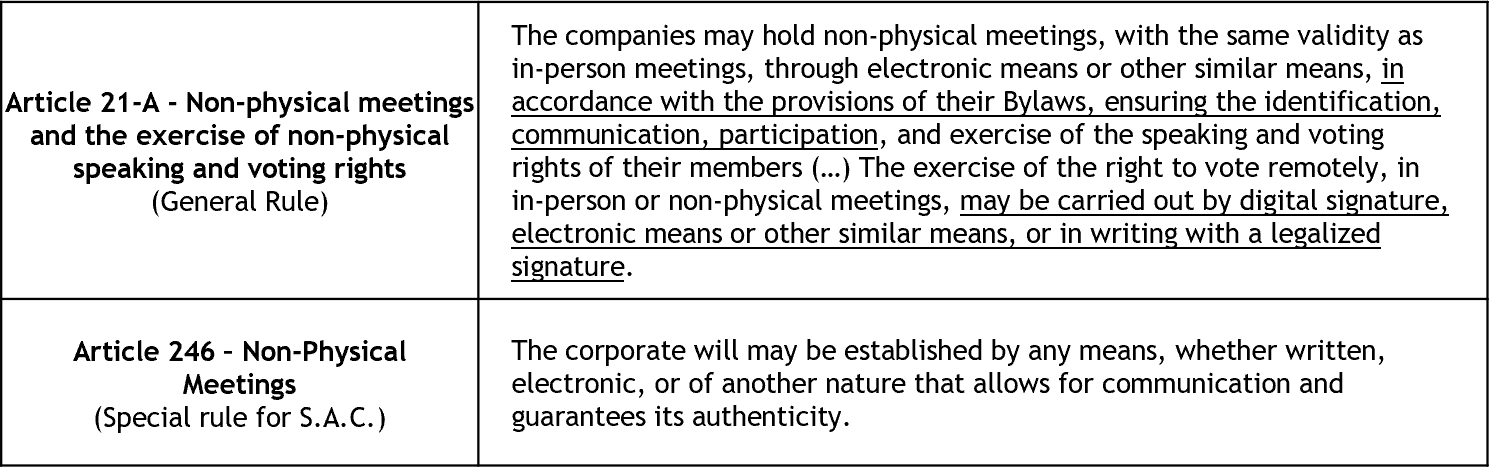
Following the appeal filed by the company, the Third Chamber of the Registry Tribunal revoked that decision. Its central argument was that, in the case of a S.A.C., there is specific legislation (Article 246 of the General Peruvian Companies Law) that allows the holding of meetings without physical presence. Thus, they may be held under that modality even when the bylaws do not contain a specific clause authorizing it. Consequently, the Tribunal considered valid the mixed meeting held in the case under review.
What does the General Peruvian Companies Law provide?
The Tribunal's analysis begins by distinguishing two provisions of the General Peruvian Companies Law:
.png?lang=en-GB)
What about electronic voting?
The General Peruvian Companies Law allows the corporate will to be established through electronic means as long as these allow for communication and guarantee authenticity. Likewise, Article 21-A expressly recognizes the possibility of exercising non-in-person voting through digital signatures, electronic means, or other similar means.
This allows us to visualize a corporate governance model in which shareholder participation can take place remotely, without this implying, in itself, a decrease in the validity of their decisions.
What advantages does it generate for companies?
- Greater remote shareholder participation
- Greater corporate flexibility
- Time and cost savings
- Continuity in decision-making
- Digitalization of corporate governance
- Greater traceability
Important: The Registry Tribunal's criterion does not eliminate the legal requirements applicable to the holding of meetings. The digitization of corporate governance should not be understood solely as using a videoconferencing platform, since the company must ensure that the mechanism used makes it possible to adequately accredit who participated, how they participated, and how they exercised their voting right.
What is the challenge for companies?
The challenge is to modernize the company's corporate governance: Designing corporate procedures that combine technological flexibility, legal certainty, and proper documentation of resolutions.
At BDO Legal and Labor Services, our team of specialists is available to advise you on reviewing your internal documents, ensuring that your corporate governance processes are prepared for an increasingly digital business reality.
For more information, you may contact us by email at: servicioslegales@bdo.com.pe.